Case study · Freight spend control · Recover stage delivered · Engagement ongoing
Line-level freight invoice recovery for a diversified investment group — every historical invoice line rated against the contract that governs it.
This documents a live engagement. The Recover stage — the exports-only invoice-recovery audit — has been built and applied to the group's freight data. Verified recovery figures are delivered to the client with the evidence behind each finding; they are not published here while the audit is ongoing.
The engagement at a glance
| Client | A London-based investment group with diversified operating businesses across sub-Saharan Africa (FMCG, construction materials, packaging, forestry, agro-processing, natural resources). Name withheld. |
| Footprint | 30+ manufacturing sites across West Africa; central procurement & supply chain run from a Mumbai Global Capability Centre. |
| Engagement | Freight spend control — line-level invoice recovery audit (the Recover stage of a four-stage freight-cost programme). |
| Delivered | Freight recovery (Recover stage) applied to the group's historical freight invoices; plus a pilot of a supplier-performance (OTIF / delay-attribution) agent. |
| Model | Exports only — no ERP, TMS or AP access required. All disputes go out under the client's name, at the client's discretion. |
| Roadmap | Protect (pre-payment), Control (contract compliance), Optimise (rate benchmarking) — later stages as access and scope expand. |
The problem
A diversified group importing materials into West Africa across 30+ sites pays an enormous volume of freight invoices, through forwarders and agents, under layered rate contracts. The money leaks not through one large error but through many small ones spread across thousands of invoice lines.
01 — No purchase order
Freight has nothing to match against.
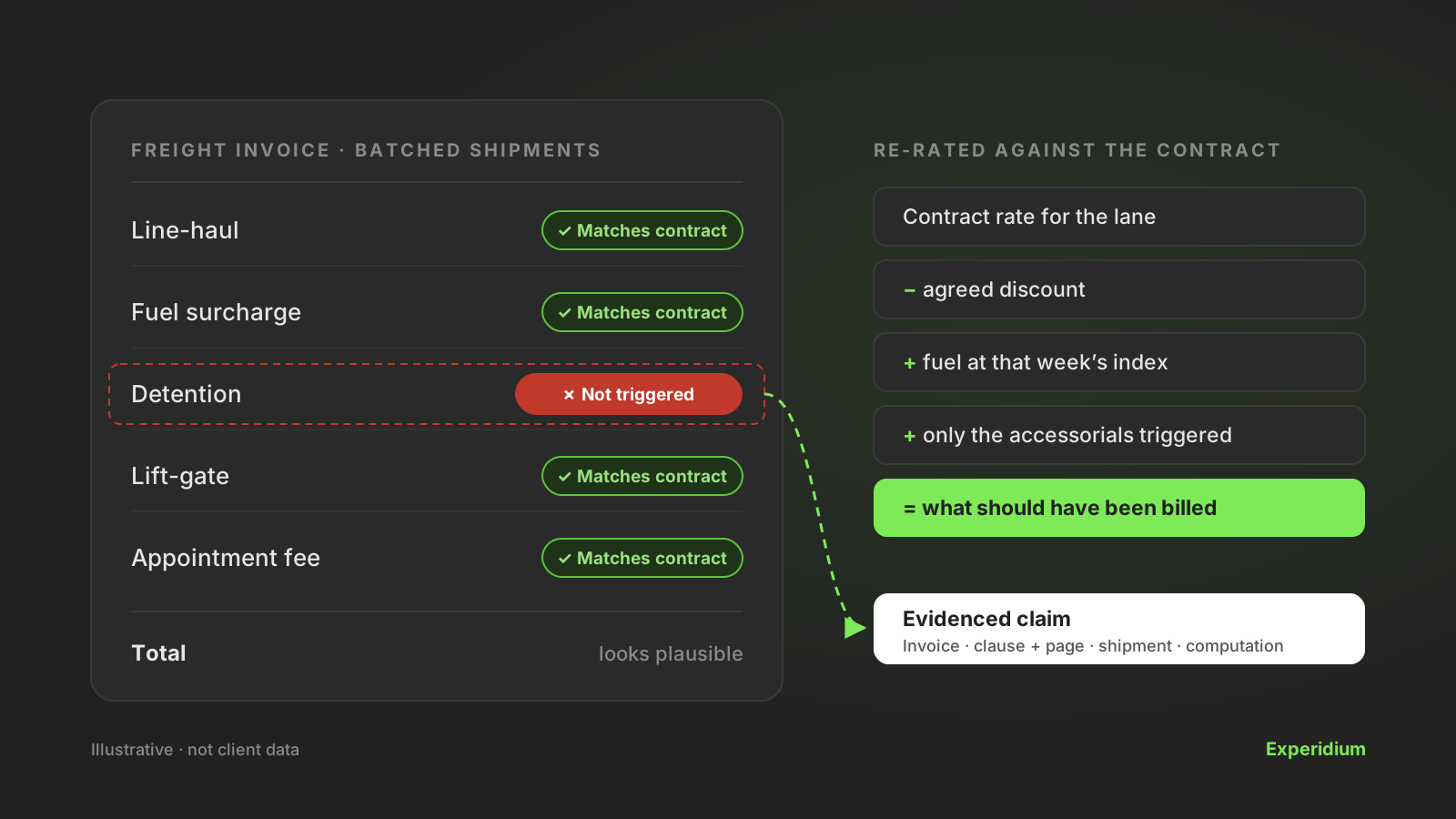
The correct amount must be recalculated from the contract rate for that lane, minus the agreed discount, plus the fuel surcharge at the correct week's index, plus only the accessorials the contract actually triggers.
Why it slips throughAn ERP can confirm a total was approved — not that it was right.
02 — One wrong line
The total still looks plausible.
A typical freight invoice carries several lines — line-haul, fuel, and accessorials such as detention, lift-gate, inside delivery, appointment fees. Four or five are usually correct.
Why it slips throughThe one wrong line is never caught.
03 — Batched invoices
A hundred shipments on one invoice.
Carriers batch a week or a month of shipments onto a single invoice. That is exactly where leakage concentrates.
Why it slips throughManual or sampling review cannot check it.
The approach: a four-stage freight-cost programme
Experidium structures freight cost control as four stages, defined by when in the payment cycle the intervention happens. Each stage needs more access than the one before it — which is why Recover is the entry point: it needs nothing from IT.
| Stage | When | Question it answers | Access needed |
|---|---|---|---|
| Recover | After payment | What have we already overpaid? | Exports only |
| Protect | Before payment | Can we stop paying it in the first place? | Invoice feed |
| Control | Continuously | Is the contract still being honoured? | Ongoing access |
| Optimise | Before contracting | Was the rate right to begin with? | Spend + benchmark data |
Why Recover first: the group entered at the exports-only stage. It carries the strongest guarantee of non-intrusiveness — no system access, no credentials — and the fastest path to value, which makes it the right first engagement for a group auditing a new vendor against its own live data.
Stage 01 — Recover · delivered
What it does: rates every historical freight invoice line against the contract that governs it, and builds an evidenced claim wherever the billed amount doesn't match. Rather than sample, the agent prices every shipment and checks every line.
Contract lane rate − agreed discount + fuel at that week's index + triggered accessorials = what should have been billed
What was built and applied to the group's data:
- Deterministic rating of line-haul, fuel and accessorials, with a full computation trace and engine versioning — so any finding can be reproduced later.
- Eight exception rules, each with its own tolerance, evidence specification and confidence score.
- Contract clause extraction with provenance verified against the source page, plus a human verification gate before any rate object can produce a claim.
- Claims tracked through to cash, with an append-only audit log.
The agent never manufactures a dispute it can't stand behind
Every line resolves to one of four outcomes. Only a definite FALSE becomes a claim.
TRUE
The line matches the contract.
Billed amount equals the re-rated amount within tolerance.
ResultNo action.
FALSE
The line provably doesn't match.
The contract condition is confirmed and the billed amount breaks it.
ResultEvidenced claim and drafted dispute.
UNKNOWN
The record can't confirm the condition.
Three-valued logic: where a shipment record can't confirm a contract condition, the result is UNKNOWN, not FALSE.
ResultNo claim is raised.
UNRATEABLE
The inputs are insufficient.
Where the data can't support a rating, the result says so with a named reason, rather than a guess.
ResultNamed reason, no guess.
Every finding carries a six-section evidence pack
- The finding
- The invoice
- The contract clause, with page reference
- The shipment record
- The computation
- The drafted dispute
Two-gate review
- Gate 1 — AnalystApproves or rejects each finding with a reason code.
- Gate 2 — ClientMarks each finding pursue or decline.
- Tracked to cashClaims followed through with an append-only audit log.
Input
Exports only
Invoices, rate contracts, shipment records. No ERP login.
Output
Evidenced claims
And drafted disputes, sent under the client's name at its discretion.
Pricing
Contingency or fixed fee
Contingency on what's credited, or a fixed fee.
Scope limits (disclosed): LTL base-tariff line-haul and mileage-based rating are excluded and stated up front.
The roadmap: Protect, Control, Optimise
Recover is the entry point. The same evidence base extends naturally into three further stages as access and scope grow — each one moving earlier in the cycle, from recovering overpayments to preventing them to pricing them right at source.
- 01 RecoverAfter payment · exports only · delivered
- 02 ProtectBefore payment · invoice feed
- 03 ControlContinuously · ongoing access
- 04 OptimiseBefore contracting · spend + benchmark data
Stage 02 — Protect · before payment
The same rules, moved ahead of payment.
A finding proven in Recover becomes a check that runs on the next invoice: pre-payment validation against contract terms, with exceptions routed to a person — hold, query or approve, with reason codes — rather than approved silently. The ruleset is promoted from proven Recover findings, so it is evidence-driven, not generic.
Trade-offNeeds an invoice feed before approval. Output shifts from claims to fewer wrong payments. Monthly retainer.
Stage 03 — Control · continuously
Checking the relationship, not the invoice.
Contract obligation tracking — rebates, volume commitments, service guarantees, review dates. Rate-drift detection against agreed tables; accessorial-creep monitoring as new charge codes appear. Carrier / 3PL scorecarding against contracted service terms, with alerts on terms approaching lapse or renegotiation.
RequiresOngoing system access. Output: alerts and compliance reporting. Retainer.
Stage 04 — Optimise · before contracting
Was what you agreed right?
Rate benchmarking; mode analysis (parcel vs LTL vs truckload); consolidation and routing analysis; bid support and scenario modelling.
RequiresHistorical spend plus benchmark data. Output: a negotiating position. Project fee.
A second workstream: supplier-performance agent · pilot
Alongside freight recovery, Experidium implemented a pilot of a supplier-performance agent for the group — aimed at a problem freight recovery doesn't touch: whether inbound suppliers are actually delivering on time, and where the blame for a late delivery really sits.
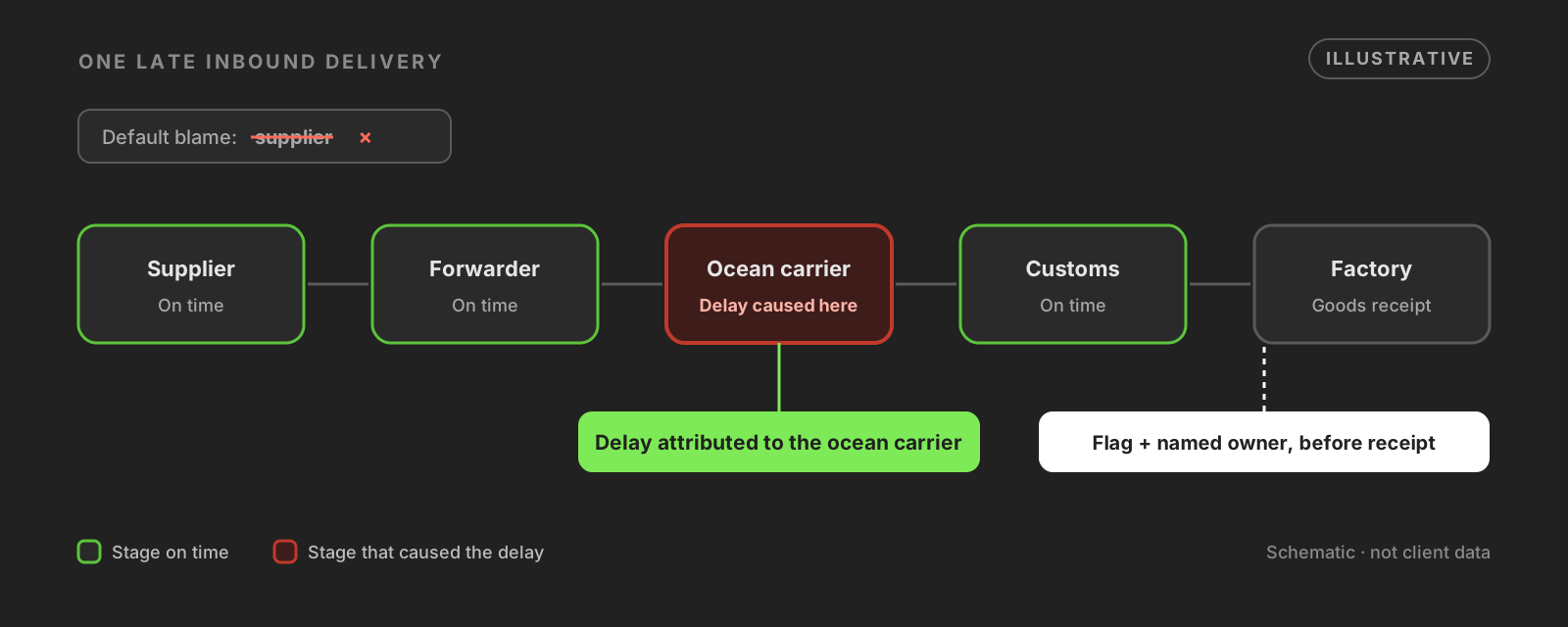
In a group whose materials move through a forwarder, an ocean carrier and a customs agent before reaching the factory, lateness is usually attributed to whoever is easiest to reach — normally the supplier — and a late delivery is only visible in the goods receipt, by which point the decision window has shut. The pilot addresses both.
What the pilot does:
- Measures on-time-in-full per supplierAcross the inbound flow.
- Attributes each delay to the stage that caused itSupplier, forwarder, ocean carrier or customs — rather than defaulting the blame to the supplier. This is the core differentiator: a causal attribution, not a status number.
- Ranks suppliers by performance, weighted by dependencySo attention goes where it matters.
- Flags suppliers trending worse, with a named ownerBefore the goods-receipt stage.
- Drafts the outreach and prices the charge-backAnd reports how often its flags were right.
A dashboard query
An OTIF percentage pulled from a spreadsheet.
What the pilot adds
- Each delay placed at the stage that caused it
- Suppliers weighted by dependency
- Deterioration flagged early, with an owner
- The resulting action drafted — the judgement and the next step, not just the metric
Status: pilot — built and running on pilot data. Verified operational outcomes are not reported here; as with the freight stage, results are confirmed with the client before publication.
Why this fits a group like this
A centralised procurement function serving 30+ sites across multiple businesses and geographies pays an enormous number of freight invoice lines, through forwarders and agents, under layered contracts. It is the textbook case for line-level recovery: the errors are many and small, the volume defeats manual checking, and the contracts are complex enough that only a recalculation against the agreement can reveal whether a total was actually right.
Because Recover is exports-only with the client in full control of any outbound dispute, it slotted alongside the group's existing systems with no integration, credentials, or disruption — and it scales to the batched, hundred-shipment invoices where the leakage concentrates. The four-stage model then gives the group a clear path from recovering past overpayments to preventing future ones, without committing to deep access on day one.
How the engagement is run
- Exports only — carrier/supplier invoices (12–24 months), rate contracts, accessorial and fuel schedules, shipment records, payment records. No ERP, TMS, WMS or AP credentials.
- Data encrypted in transit and at rest, never used to train any model, and deleted at the end of the engagement.
- Every finding human-reviewed before it reaches the client; nothing reaches a carrier without the client's approval.
- Relationships stay with the client — Experidium never contacts carriers or suppliers.
Status & next steps
- Freight recovery (Recover) — built and appliedFindings delivered with evidence for the group to pursue or decline.
- Supplier-performance agent — running as a pilotOperational outcomes to be confirmed with the client.
- Verified outcomes — confirmed as they are realisedRecovery and performance results to be added here as the engagement matures.
- Protect, Control and Optimise — available nextLater freight stages as access and scope expand.
Recover stage delivered. Engagement ongoing. Verified recovery figures to follow.
Ready to put your supply chain on autopilot?
Book a discovery call. We'll talk through your biggest supply chain pain points and where AI agents could help.