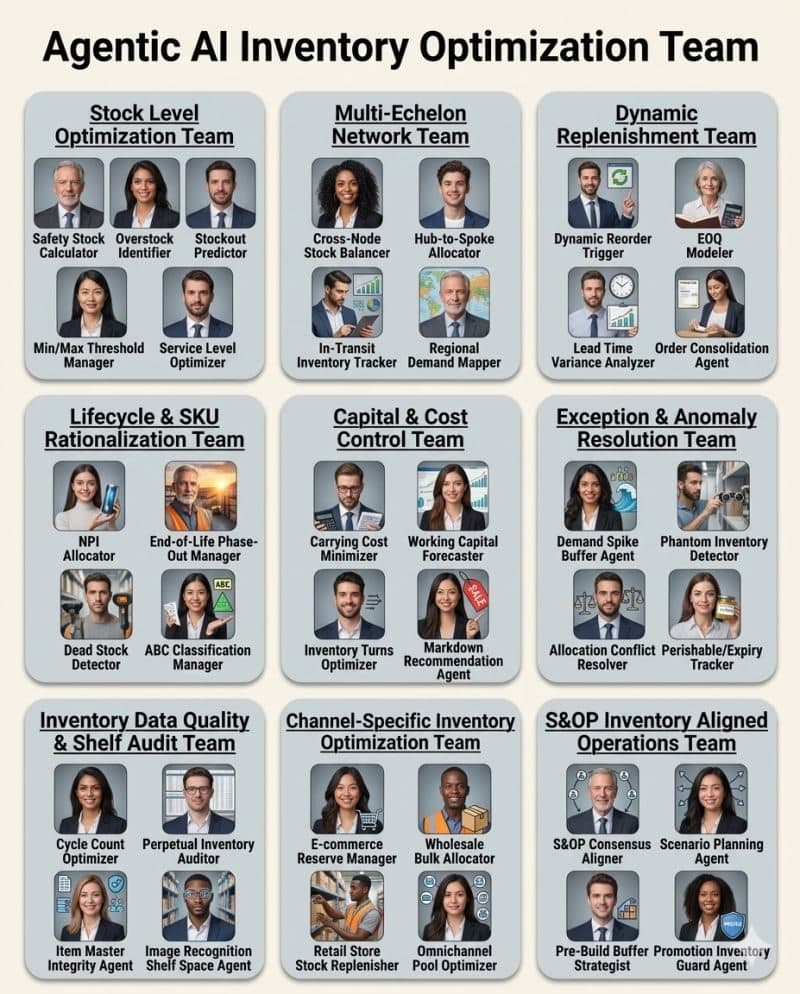
What We Built
We built an Agentic AI inventory optimization system at Experidium — and it just exposed 1,500+ potential stockouts before a single shelf went empty.
This isn't a concept or a prototype. It's a working system that actively monitors, simulates, and recommends — so your team can act before the crisis hits, not after.
The Problem
What happens when a key supplier is delayed by 7 days? Most teams find out only after shelves go empty.
Traditional inventory systems are built to report what already happened. They show you dashboards of past performance, trigger alerts when stock hits a threshold, and leave your team scrambling to react. By the time a stockout is visible, the damage is already done — lost sales, frustrated customers, and a supply chain team working overtime to fix something that could have been prevented.
Our agentic AI system simulated the disruption and instantly mapped the ripple effect:
1,500+ SKUs at risk
40,000+ units impacted
Multiple warehouses trending toward stockout
Reorder points no longer sufficient
Service levels about to drop
Why Traditional Tools Fall Short
Most inventory tools are passive. They sit behind a login, wait for someone to check them, and surface data that's already stale by the time a decision is made.
The real problem isn't a lack of data — it's a lack of intelligence acting on that data in real time. Procurement teams are stretched thin. Warehouse managers are juggling dozens of priorities. Nobody has the bandwidth to manually simulate every supplier risk, every demand spike, or every logistics delay.
That's exactly the gap this system was built to fill.
What the AI Agents Do
Instead of static rules, the AI agents:
Continuously monitor inventory health
Simulate supplier disruptions proactively
Predict stockouts before they happen
Re-optimize reorder points dynamically
Recommend inter-warehouse transfers
Quantify revenue & service level risk
Each agent operates with a specific role — some watch supplier signals, some track demand trends, some run disruption simulations, and some calculate the financial impact of inaction. Together, they form a system that thinks ahead so your team doesn't have to.
The Results That Matter
When we ran a simulated 7-day supplier delay through the system, the output was immediate and precise. Within seconds, the agents had:
Identified every SKU affected across all warehouse locations
Ranked them by risk severity and revenue impact
Flagged which reorder points needed to be updated
Suggested specific inter-warehouse transfer actions
Estimated the service level drop if no action was taken
This level of analysis would take a human team days. The AI did it in real time.
Who This Is Built For
This system is designed for operations and supply chain teams at mid-to-large businesses who are tired of reactive planning. If your team is constantly putting out fires, living in spreadsheets, or finding out about stockouts from an angry customer email — this is what solving that problem looks like.
It's also for leadership teams who want to see inventory risk quantified in terms they understand: revenue at risk, service level impact, and cost of inaction.
What's Next
This is phase one. The roadmap includes deeper supplier integrations, demand forecasting layered on top of the disruption simulation, and a self-healing reorder engine that executes approved recommendations automatically.
The goal is simple: a supply chain that doesn't wait to be managed.
Pages in This Resource
System Overview — What this platform does and how it works
Technical Architecture — Stack, graph model, phased build plan
Key Metrics & Targets — Performance benchmarks
Competitive Positioning — Where this fits in the market